

EXECUTIVE SELECTION WITH HOGAN ASSESSMENTS
Bring research-backed rigor to executive selection
High-stakes hiring and promotion decisions deserve more than polished interviews and good instincts.
Hogan assessments add personality data grounded in decades of validated research, offering insight into how a finalist is likely to lead, respond under pressure, and shape the working environment around them.
I interpret those results in the context of the role, organization, and existing management team—then translate the findings into questions and lines of inquiry the hiring team can use. Combined with interviews, references, and informed judgment, this creates a more rigorous basis for the decision.
Interviews are essential—and incomplete
Interviews reveal a great deal about a candidate’s experience, judgment, and ability to communicate. But when finalists are accomplished and well prepared, consequential differences can be difficult to see.
Hogan examines three complementary dimensions of leadership:
Hogan Personality Inventory — day-to-day leadership
The HPI provides insight into how a candidate is likely to approach work, relationships, decisions, learning, and leadership.
Hogan Development Survey — leadership under pressure
The HDS identifies tendencies that can become derailers when overused—particularly when a leader is stressed, fatigued, or no longer carefully managing how they come across.

Motives, Values, Preferences Inventory — underlying drivers
The MVPI examines the motives and values that shape a leader’s priorities, decisions, and the culture they are likely to create.
Together, the findings give the hiring team a fuller view of the candidate and identify what merits closer examination. They become hypotheses to investigate—not conclusions imposed on the process.
Rigor comes from interpretation and context
The value is not simply in administering an assessment or reading individual scores. It comes from interpreting patterns across the three inventories, relating them to the demands of the role, and integrating the findings with what the hiring team has learned elsewhere.
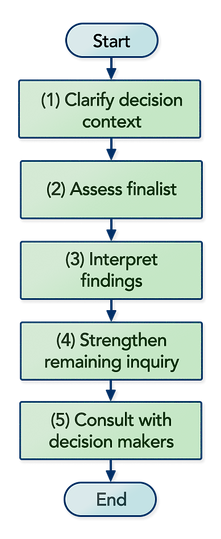
1. Clarify the decision context
We begin with the role—its priorities, challenges, operating environment, and the team the executive will join.
2. Assess the finalists
Finalists complete the HPI, HDS, and MVPI online, generally in about an hour. The purpose and process are explained in advance.
3. Interpret the pattern
I examine how the results across the three inventories interact, focusing on likely strengths, responses under pressure, motivations, and potential concerns in this particular role.
4. Strengthen the inquiry
%2C%20v3.png)
I translate the findings into candidate-specific questions and areas to examine through follow-up interviews, references, and other parts of the selection process.
5. Integrate the findings
In a focused consultation, we bring the Hogan findings together with what the hiring team has learned elsewhere—not to produce a score-based recommendation, but to support a more rigorous, better-informed discussion.
A decision aid, not a verdict
Hogan is not a pass/fail test, and no assessment can guarantee hiring success. A personality pattern that is an asset in one role, organization, or management team may present a risk in another.
The results are most useful when interpreted in context and considered alongside structured interviews, professional history, references, work samples, and informed human judgment.
Support for search partners and internal hiring teams
For executive-search professionals
I can work as a client-facing assessment partner or support the search team behind the scenes, integrating Hogan into your established process while preserving your ownership of the client relationship and overall search.
For organizations
I work directly with founders, People executives, boards, and other senior decision-makers evaluating external candidates or internal promotions for consequential roles.
Experienced interpretation matters
The assessment scores are a starting point, not a conclusion.
Russ Powell has more than 30 years of experience in organizational and leadership development. He is Hogan-certified, with advanced certifications in Interpretation and Feedback. He combines a detailed understanding of Hogan data with a practitioner’s perspective on how senior leaders affect decisions, relationships, execution, and the people around them.
He looks across all three inventories, considers the tensions and interactions within the profile, and connects that pattern to the demands of the actual role.
Bring greater rigor to the decision
If you are evaluating finalists for a consequential executive hire or promotion, let’s discuss where Hogan could add value—and where it would not.
Looking for Hogan as part of executive development rather than selection? Explore executive coaching.