

LEADERSHIP COACHING
A place to think clearly when the stakes are high
Practical, confidential coaching for CEOs, founders, and other senior executives working through difficult decisions, high-stakes conversations, and recurring leadership challenges.
At the senior level, the hardest challenges rarely belong to just one part of the business. A decision about a person may also affect performance, culture, investor confidence, and the management team’s ability to operate without your intervention.
Coaching gives you confidential room to examine the situation candidly, test your thinking, and decide how to proceed.
When coaching can be useful
Senior executives often turn to coaching when:
-
Too many important decisions still make their way back to them, even with capable managers in place
-
They face a decision with legitimate competing concerns and no clean answer
-
They are preparing for a high-stakes conversation with an employee, partner, board member, or investor
-
The leadership habits that helped build the company are becoming less effective as it grows
-
They notice that, in response to pressure, they’ve become more controlling, avoidant, reactive, or certain than they intend to be
The goal is not to provide generic advice or turn you into someone else. It is to help you see the situation more clearly, expand your choices, and act with greater intention.
What working together looks like
Our conversations stay connected to real work. You bring the decisions, conversations, responsibilities, and recurring problems that deserve your attention. Together, we slow them down enough to examine what is happening, challenge assumptions, and consider options you may not have seen.
You may leave with a conversation to conduct, an assumption to test, or a different approach to try. When we meet again, we look at what happened, what you learned, and what you want to do next.
I’ll offer questions, observations, frameworks, and candid feedback. The conversation is confidential, and you remain responsible for deciding what fits your situation and what you will do next.

“As my team grew, I started running into challenges communicating with them and navigating the day-to-day of running projects. Russ helped me communicate more effectively with my team and structure my days for greater impact with both my team and my clients.”
– Ashley Gomez
Founder
Digital Twinners

“I was fortunate enough to have six sessions with Russ. These sessions were incredibly insightful and helpful, as we explored frameworks for breaking down, understanding, and solving problems that I was facing at work.”
–Harry Morton
Product Manager
Windfall
How the engagement works
I typically structure coaching in seven-hour blocks. That gives us enough time to establish a meaningful focus, apply the work to real situations, and see whether continuing would be useful—without requiring an open-ended commitment.
For executive coaching, the first block begins with the full Hogan Leadership Assessment suite. We spend two hours together interpreting the results, followed by five one-hour coaching sessions.
Hogan gives us a useful starting point for understanding:
-
How others are likely to experience you day to day
-
Patterns and blind spots that can interfere with your effectiveness
-
The values and motivations that influence your decisions
Subsequent blocks consist of seven one-hour sessions and continue wherever the work is producing the most value.
Coaching is also available for managers and others with significant responsibility. In those cases, I adapt the starting point and structure to the person and the work in front of them.
Using Hogan for hiring or promotion? Learn about Hogan for executive selection.
Coaching grounded in the Middle Path
The Middle Path is central to how I coach. It helps us look beyond the first explanation, question apparent either-or choices, and find ways to address concerns that can seem to compete with one another.
Senior executives regularly face tensions such as:
-
Holding people accountable while remaining supportive
-
Moving quickly while involving the right people
-
Producing business results while operating with integrity
-
Retaining appropriate control while giving others meaningful authority
-
Speaking candidly while protecting an important relationship
The aim is not to split the difference. It is to understand what matters on both sides and look for a response that addresses both as fully as possible.
The Middle Path at a glance
This table summarizes several Middle Path principles I draw on frequently in coaching and workshops.
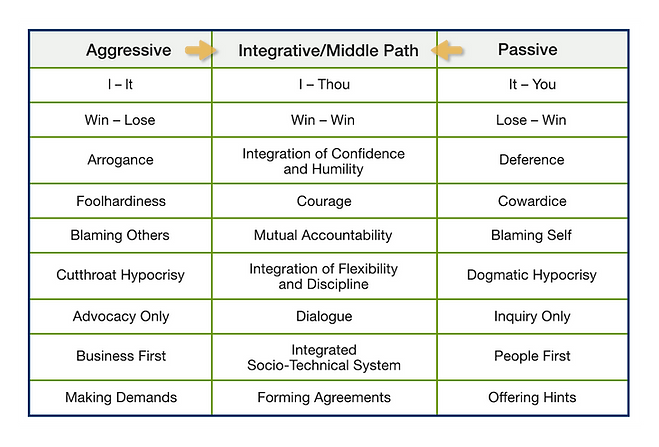
You may recognize yourself leaning toward one side or the other depending on the situation. The point is not perfect balance. It is to notice when an either-or choice may be narrowing your thinking—and look for a better way forward.
Coaching one person—or strengthening the management system?
If the same challenges are showing up across several managers, coaching one person may not be the whole answer. In those situations, I may recommend looking at the management team as a system through the Collaborative Leadership System.
About Russ
I’ve spent more than 30 years helping leaders and management teams work through difficult problems, build stronger working relationships, and lead more effectively. My background spans psychology and the behavioral sciences, organizational development, leadership development, facilitation, and executive coaching, working with leaders in growing companies as well as large global organizations.

I’m also certified in Hogan Assessments, including Advanced Interpretation and Advanced Feedback.